Showing posts with label Marsupial. Show all posts

Thursday, August 11, 2011

Quokka


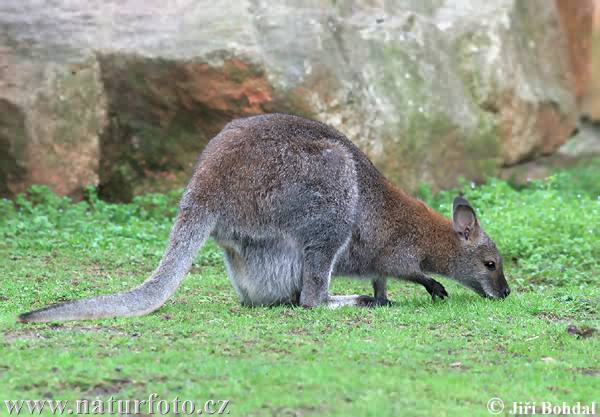
True Wild Life | Quokka | The Quokka is a small macropod about the size of a domestic cat. Like other marsupials in the macropod family , the Quokka is herbivorous and mainly nocturnal. It can be found on some smaller islands off the coast of Western Australia, in particular on Rottnest Island just off Perth and Bald Island near Albany. Quokkas resemble a small wallaby, with small rounded ears, and brown or greyish fur.


In the wild, its roaming is restricted to a very small range in the South-West of Western Australia, with a number of small scattered populations on the mainland, one large population on Rottnest Island and a smaller population on Bald Island near Albany. The islands are free of foxes and cats. On Rottnest, it is common and occupies a variety of habitats ranging from semi-arid scrub to cultivated gardens.


Quokka weighs 2.5 to 5 kg and is 40 to 90 cm long with a 25 to 30 cm tail  which is rather short for a macropod. It has a stocky build, rounded ears, and a short, broad head. Although looking rather like a very small, dumpy kangaroo, it can climb small trees and shrubs. Its coarse fur is a grizzled brown colour, fading to buff underneath.


Quokka feeds at night on native grasses and the leaves of shrubs. They need drinking water, but can survive long periods without it. This is helped by the remarkable ability of the Quokka to reuse a portion of their bodies waste products. These animals breed year round, and have a gestation period of 4 months before a new joey is born. The joey lives in its mother's pouch for the first 25 weeks of its life. After leaving the pouch, the joey continues to suckle at its mother's teets for a further 10 weeks.


There were once a lot of Quokkas, but they are now in danger of extinction. They are under threat from development that has destroyed the wetlands where they live and are also threatened by other animals that have been introduced by humans. Quokkas are preyed on by cats and foxes, who are non-native animals in Australia. Their wetland habitat is also disturbed by feral pigs. While efforts are being made to protect them, it is thought that the numbers of Quokka still have not recovered.

Wednesday, August 10, 2011

Huon Tree Kangaroo


True Wild Life | Huon Tree Kangaroo | Huon Tree Kangaroo (Dendrolagus matschiei), also known as the Matschie's Tree Kangaroo is a tree kangaroo  native to the Huon Peninsula of North Eastern New Guinea. Under the IUCN classification, Huon Tree Kangaroo is endangered. With a body and head length of 20 to 32 inches, Huon Tree Kangaroo are much smaller than Australia's well-known red kangaroo. 


There is no particular season in which they breed. Gestation lasts 32 days and joeys of captive bred individuals leave the pouch after 13 ½ months. The average life span of the Huon Tree Kangaroo in the wild is unknown, but is at least 14 years. The life span of the kangaroo in a zoo is about 20 years. The Huon Tree Kangaroo can only be found on the Huon Peninsula on the northeast coast of Papua New Guinea. They live in forests that are usually foggy.Unlike other species of kangaroos, the Huon Tree Kangaroo spends most of its time living in trees. They even eat and sleep in trees.


The most distinctive trait of all tree kangaroos is the hair whorl they possess. It is a patch of hair that goes out in many directions and its location ranges from up near the shoulders all the way down to the tail. The Huon Tree Kangaroo is golden on its ventral side, lower parts of its limbs, ear edges, belly, and tail, and the rest of its body is a chestnut brown color, except for usually having a dark stripe down its back. Their faces are typically an array of yellow and white colors. The Huon Tree Kangaroos are similar in color and size to Dendrolagus dorianus, the Doria’s tree kangaroo. Huon Tree Kangaroos ears are small and bear-like looking and they do not have a good sense of hearing because of it. They have curved claws on their forelimbs and soft pads on their hind limbs that aid in their climbing ability, and they have some independent movement of their digits as well as good dexterity due to their forelimbs being able to bend a great deal.


The Huon Tree Kangaroo are mainly folivorous, eating anything from leaves, sap, insects, flowers, and nuts.  Since they eat high fiber foods, they only eat maybe about 1 to 2 hours throughout the day and the other time of the day they are resting and digesting their food. Their digestion is similar to that of the ruminants; they have a large, “tubiform forestomach”, where most of the fermentation and breakdown of tough material takes place at; in the hind stomach, there is a mucosa lining with many glands that help absorption begin here.


The Huon Tree Kangaroo lives only on the Huon Peninsula of Papua New Guinea. Usually we think of kangaroos as animals that hop around grasslands. However, Huon Tree Kangaroos are an exception. They live in forests and are more adept at climbing trees than they are at moving on land. Today, as the population on the Huon Peninsula grows, more and more of the kangaroo's precious forests are being converted into farmland. Continued habitat loss is pushing the Huon Tree Kangaroo toward the brink of extinction.

Goodfellow's Tree Kangaroo

 
True Wild Life | Goodfellow's Tree Kangaroo | Goodfellow's Tree-kangaroo also called the Ornate Tree Kangaroo, belongs to the family Macropodidae, which includes kangaroos, wallabies and their relatives. The species is native to the rainforests  of New Guinea, and the border of central Irian Jaya in Indonesia.  Under the IUCN classification, the species is listed as Endangered, which is a result of overhunting and human encroachment on their habitat.


Like other tree-kangaroos, Goodfellow's Tree-kangaroo is quite different in appearance from terrestrial kangaroos. Unlike its land dwelling cousins, its legs are not disproportionately large compared to its forelimbs which are strong and end in hooked claws for grasping tree limbs, and it has a long tail for balance. All of these features help it with a predominantly arboreal existence. Goodfellow's Tree-kangaroo has short, woolly fur, usually chestnut to red-brown in color, a gray-brown face, yellow-colored cheeks and feet; a pale belly, a long, golden brown tail, and two golden stripes on its backside.  It weighs approximately 7 kg. 


Although it feeds mainly on the leaves of the Silkwood tree, other morsels are accepted when available, including various fruits, cereals, flowers and grasses.  It has a large stomach that functions as a fermentation vat, similar to the stomachs of cows and other ruminant  herbivores, where bacteria break down fibrous leaves and grasses.


Unlike other kangaroos, Goodfellow's Tree Kangaroos like to stay in the treetops rather than hopping around on the ground. They choose to live in the treetops to protect themselves from enemies on the ground. The New Guinea Island used to be rich in nature but as it became the major exporter of lumbers and minerals, the forests were destroyed by the human. The more and more safe places to live for Goodfellow's Tree Kangaroos are now disappearing.


To make the matters worse, roads have been extended to the middle of a forest. It has made Goodfellow's Tree Kangaroos an easy prey for hunters who go after their meat. They are usually active in the morning and evening but those who live in the area where there are many people have become nocturnal. Once they chose to live in the treetops to protect themselves from the enemies; maybe now they have changed their lifestyle for fear of human, their new enemies.

Thursday, April 7, 2011

Wombat


True Wild Life | Wombat | The wombat is a medium sized marsupial that is found only in Australia and it's surrounding islands. Wombats are burrowing mammals that spend most of the day under ground, coming out at night to feed. The common wombat is thought to be a descendant of the giant wombat that existed around 50 million years ago. The giant wombat's extinction is said to be caused by hunting and changes to their environment including pollution and habitat loss.


The common wombat is a nocturnal herbivore and gets to about 26 years old in the wild although some wombat individuals have been known to live for longer in captivity. Wombats eats grasses, shoots and bark which the wombat needs to keep gnawing on in order to keep it's continuously growing teeth at a manageable size. Like all other marsupials, the female wombat has a warm pouch on it's belly in which the wombat babies are nurtured for the first few months of life. When the baby wombats are first born they are very small and undeveloped and crawl into the mother wombat's pouch almost immediately. The baby wombat stays in the pouch of the mother wombat until the baby wombat is around 5 months old. By the time the baby wombat is roughly 7 months old, it is able to care for itself.


Wombats have long claws which they use to dig burrows. Wombat burrows can easily become an extensive network of underground tunnels leading to small chambers. Most wombats are solitary animals but some wombats have been known to form underground colonies with other wombats.


Wombats have a few natural predators including foxes and dingos. Although the wombat is relatively defenceless when it is out and about, wombats are generally well protected in their underground burrows as many predators cannot follow the wombat into the narrow, complex tunnels. Today the wombat is considered to be an endangered species of animal. Wombat numbers have been decreasing rapidly due to habitat loss and hunting by humans who believe the wombat and it's network of underground tunnels to be an agricultural pest.

Sunday, March 27, 2011

Wallaby


True Wild Life | Wallaby | The wallaby is a small to medium sized marsupial found on the Australian continent and its surrounding islands. Today there are a number of wild wallaby populations inhabiting other areas around the world where the wallaby has been introduced by humans. The wallaby is most closely related to Australia's largest marsupial, the kangaroo. The wallaby is generally smaller than a kangaroo although some wallaby individuals have been known to reach 6ft tall.


There are roughly 30 different species of wallaby found in a variety of habitats throughout the Australian continent. The habitats of wallaby are so diverse that wallaby species are often named after their habitat. This includes the rock wallaby, the brush wallaby and the shrub wallaby. Other wallaby species such as the hare wallaby, are named after their size and appearance.


The wallaby has strong and powerful back legs which the wallaby hops on in order to move about. The forearms of the wallaby are much smaller as they are mainly used for feeding and occasionally to help with balance. The tail of the wallaby is often as long as the wallaby's body and plays a critical role as a balance aid and is often used in self-defence.animal that forages on the ground for seeds and fallen fruits. Grasses make up the bulk of the wallaby's diet along with leaves from low trees and shrubs and berries. The wallaby is a very sociable animal and can often be seen foraging for food with other wallaby individuals.


Due to its relatively large size, the wallaby has few natural predators within its environment. Canines such as dingos and foxes are the main predators of the wallaby along with large reptiles such as crocodiles and snakes. The wallaby is able to defend itself against predators by hitting them with its long, powerful tail. The wallaby is a marsupial meaning that the female wallaby has a pouch on her tummy in which to raise her young. The female wallaby gives birth to a single baby wallaby (occasionally twins), known as a joey, after a gestation period of only a month. The joey then crawls up into its mother's pouch, where it is cared for and nurtured until it is fully developed.

Friday, March 25, 2011

Tasmanian Devil


True Wild Life | Tasmanian Devil | The Tasmanian devil is a carnivorous marsupial and the Tasmanian devil is therefore distantly related to kangaroos and wombats. Although the Tasmanian devil's closest relative is a kangaroo, the Tasmanian devil has the appearance of a wild dog The Tasmanian devil is only found on the Australian island state of Tasmania. The Tasmanian devil is characterized by their black fur and the offensive odour the Tasmanian devil secretes when stressed. The Tasmanian devil is also known to making a horrible, loud screeching sound when the Tasmanian devil is distressed or feels threatened.


Since the late 1990s, a nasty facial mutation disease has caused the Tasmanian devil population to decline, meaning that the Tasmanian devil is now an endangered species. The facial mutation disease is thought to be a type of cancer and ends in fatality about a year after it is contracted. The Tasmanian devil is very fierce, but that does not mean we shouldn't try to save them. If people shoot them because they attack something, that is like killing a friend, there will soon be no more.


The Tasmanian devil known to display odd and slightly psychotic behaviour. When the Tasmanian devil feels threatened by a predator, is competing for mate or even a male, the Tasmanian devil displays a series of behaviours including lunging, teeth-baring and growling. The Tasmanian devil turns to rage so quickly that European settlers first named it the devil. Tasmanian devils are highly carnivorous and survive on snakes, birds, fish, insects and road kill. When a carcass is found, Tasmanian devils are known to be one of the loudest animals when it comes to fighting for a meal.


Tasmanian devils are solitary animals and are nocturnal. The Tasmanian devil rests in burrows, caves and hollow logs during the day and then come out at night to find food. Tasmanian devils use their long whiskers and fantastic sense of smell to find prey whilst avoiding troublesome predators. Female Tasmanian devils give birth after about three weeks of pregnancy to 20 or 30 very tiny young. These tiny Tasmanian devil babies crawl up their mother's fur and into her pouch where they are kept safe as well as fed. However, only a few of the Tasmanian devil babies will survive as the mother cannot feed them all at once. The baby Tasmanian devils leave the safety of their mother's pouch when they are about 4 months old and are big enough and strong enough to make it on their own when they are 8 months old.