Showing posts with label Turtle. Show all posts

Saturday, May 7, 2011

Yellow-margined Box Turtle


True Wild Life | Yellow-margined Box Turtle | The Chinese box turtle is a species of Asian box turtle with several names. Its common names include Chinese box turtle, 食蛇龜 Snake-eating turtle, Yellow-margined box turtle, and Golden-headed turtle. Taxonomically, it has been called Cistoclemmys flavomarginata, Cuora flavomarginata, and Cyclemys flavomarginata. The Integrated Taxonomic Information System uses Cuora flavomarginata.
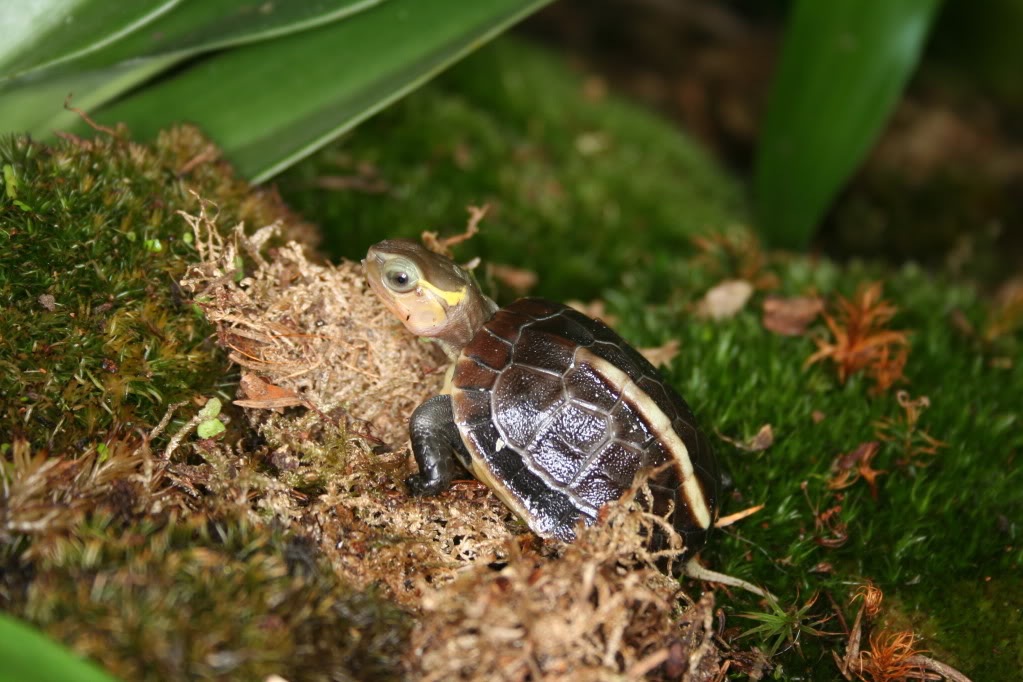

Yellow-margined Box Turtle has a highly domed shell, the carapace and plastron of which are a dark brown, excepting a cream-yellow stripe on the vertebral keel. The edge of the plastron is lightly pigmented due to the marginal scutes' and plastral scutes' lighter pigmentation near their edges. The skin on the limbs is brown in color while the top of the head is a pale green. Each side of the head has a yellow line extending from behind the eye backward. The skin beneath the head and between the limbs is a lighter pink-ish color.


The name box turtle refers to C. flavomarginata's ability to bring the plastron to the edges of the carapace. This is enabled by a hinge on the plastron and ligaments connecting the carapace and plastron, which allows for limited movement. The forefeet have five claws, while the rear have four.


The external difference between male and female Yellow-margined Box Turtle is slight. Males have a broader tail than females; it is almost triangular in shape.

Painted Batagur


True Wild Life | Painted Batagur | The Painted Batagur is the largest turtle living in fresh water. They are in danger of extinction because people take them as pets or to eat, and because of the deteriorating environments in and around the rivers they live in. Painted Batagurs live on the Malaysian peninsula, Sumatra Island, and Kalimantan Island.


Painted Batagurs live in rivers and sometimes go near the ocean where the seawater mixes with the fresh water. They also lay eggs in sandy beaches like Green Turtles. Young Painted Batagurs eat other animals and plants. Once they become adults, their diet changes to mainly leaves and other plants.


The number of Painted Batagurs is declining because people capture them to eat, in addition to river water pollution and deteriorating surrounding environments. In Thailand, where the Painted Batagur is on the brink of extinction, there are strict restrictions against their capture, sale, or purchase. Additionally, there are efforts to increase their number by breeding. Although there are international restrictions against the sale and purchase of Painted Batagurs, there are still many efforts that need to be made to recover their numbers, such as making river environments safe for living in.

Ryukyu Black-breasted Leaf Turtle


True Wild Life | Ryukyu Black-breasted Leaf Turtle | The Ryukyu black-breasted leaf turtle or Ryukyu leaf turtle, Geoemyda japonica, is a species of turtle in the family Geoemydidae (formerly Bataguridae). It is endemic to the Ryukyu Islands in Japan. In 1975 the species was designated a National Natural Monument of Japan. It grows to approximately 5–6 inches long. In captivity it feeds on worms, snails, insects, and fruit. Due to its rarity and very attractive appearance, this species is highly coveted by turtle collectors worldwide.


The Ryukyu black-breasted leaf turtle  has a flattish brown, chestnut, mahogany or tan carapace that is serrated front and rear, with three keels. The plastron is black or dark brown with yellow or yellow-cream rings. The skin of the Black-breasted Leaf Turtle is dark with colored spots or mottles, and females have a yellowish-cream stripe down each side of the head. Its feet are only semi-webbed, and it has large bulging eyes with white irises.


At first it was considered a subspecies of Geoemyda spengleri, and named Geoemyda spengleri japonica. It was redescribed as a separate species and given its current binomial name in 1992.